
We Tested 7 AI Answering Services for Small Business
At Smashvc, we’ve backed dozens of small businesses now weighing whether to bring in an AI virtual receptionist. The decision rarely comes down to chasing shiny new tech. It’s about answering more calls, cutting overhead, and booking more appointments without expanding the front desk.
So we ran nearly a dozen of these services through real-world testing across our portfolio companies. Some shined for solo home services operators. Others held up across 50+ location franchises. A few flopped. Below are the seven we’d actually deploy, the situations each one fits best, and what we learned testing them.
Quick Picks: Our Top 3 AI Answering Services
If you don’t have time for the full breakdown, these are the three we recommend most often.
1. Rosie AI — Best Overall for Small Businesses
Rosie was the best fit for most of our portfolio companies, from a single-location plumber to a 50+ location oil change franchise.
- Genuinely human-sounding voice
- Setup completed in under an hour
- Unlimited minutes starting at $49/month
- Multichannel: voice, text, and chat in one place
2. Emitrr — Best for Appointment-Heavy Workflows
- Built for industries related to healthcare
- HIPAA-compliant configurations for medical practices
- Direct integration with most major EMRs and CRMs
3. Slang — Best for Restaurants and Hospitality
- Hospitality-specific virtual receptionist
- Handles multiple simultaneous calls during dinner rush
- Native integration with reservation platforms
Want the full breakdown? Keep reading. The complete reviews are below.
At-a-Glance Comparison
| Service | Best For | Starting Price | Standout Feature |
|---|---|---|---|
| Rosie AI | Small businesses overall | $49/mo | Multichannel + unlimited minutes |
| Emitrr | Healthcare-heavy practices | Custom | HIPAA-compliant booking flows |
| Slang | Restaurants and hospitality | Custom | Multi-call handling during peak times |
| Numa | Lead recovery from missed calls | Custom | SMS follow-up on missed calls |
| AnswerConnect | Frequent escalation needs | Custom | Hybrid AI + 24/7 human agents |
| Nexa | Complex, high-stakes calls | Custom | Trained human handling on top of AI routing |
| Air AI | Long-form sales conversations | Custom | Sustains 10–40 minute calls naturally |
How We Evaluated These AI Phone Systems
Our review leans practical. A spreadsheet ranking with columns for “voice quality” and “feature count” looks tidy, but it doesn’t capture whether a tool actually works when a frustrated customer calls at 8:47 PM on a Saturday. So instead, we ran each service against the questions a business owner actually has to ask.
1. Does It Actually Reduce Admin Effort?
Common, frustrating scenario: you find an AI phone agent that takes calls, but it generates so much downstream cleanup that staff spend more time fixing transcripts than they would have spent answering the phone. A real receptionist replacement fields the call, captures the data cleanly, and routes the next step without your team picking up the slack.
2. Does It Slot Into Existing Workflows?
The hallmark of a good tool is how easily it bends to your existing systems. A great AI answering service shapes itself around your CRM, calendar, and ticketing tools. The bad ones force you to rebuild your operation around them.
3. Can It Handle Real-World Complexity?
Demos are misleading. They follow scripts that real customers never use. Real callers don’t say “I’d like to schedule a follow-up appointment for my routine cleaning on Thursday at 3pm.” They say “Yeah hey, my tooth is killing me, I think it’s the one I had filled, can someone look at it tomorrow morning?” A good AI service handles the second one without dropping the call to a human.
4. Does It Sound Authentic?
Customers disengage fast when they sense they’re talking to a robot. Many people still carry years of frustration from dealing with stubborn IVR menus. The best AI answering systems sound human enough that callers don’t immediately try to mash 0 to escape.
5. Can It Handle a Variety of Call Types?
Most businesses field a mix of urgent support, sales inquiries, scheduling requests, and the occasional angry customer who needs an immediate escalation. The best AI services manage all of these without human intervention. The mediocre ones do one thing well and bottleneck on the rest.
What to Consider Before Choosing One for Your Business
There’s a difference between evaluating the objective quality of an AI answering service and finding the one that’s right for your specific business. We’re handling the first part. You’ll need to handle the second.
To make that easier, ask yourself the following.
1. What Do Your Inbound Calls Actually Look Like?
Most businesses field a spectrum, but most lean in one direction. Long, technical support conversations? Quick transactional queries? Rescheduling appointments? Two questions worth answering:
- What types of calls do you handle most often?
- What types do you almost never handle?
Knowing both helps narrow the field fast.
2. What Industry Are You In?
Several services on this list are built for specific verticals (healthcare, hospitality, home services). When the use cases match, those tools tend to outperform generalist alternatives by a wide margin.
3. What Software Does It Need to Talk To?
Some services offer native integrations with the big platforms (Salesforce, HubSpot, Microsoft Teams). Others connect through Zapier. A few are isolated. Make a list of every tool that should know about an inbound call before you start evaluating.
4. How Often Do Calls Need to Escalate?
If a meaningful share of your calls require routing to a specific human, you’ll need a service with granular escalation logic. That means support for:
- Multiple human operators with distinct routing rules
- Different trigger conditions (keyword, sentiment, customer tier, time of day)
5. Are You Subject to Compliance Rules?
If you’re in healthcare, financial services, or legal, regulatory requirements extend to your call handling. The wrong choice here can create real legal exposure. HIPAA, PCI, and similar standards aren’t optional, and not every AI receptionist is built to comply.
The 7 Best AI Answering Services for Small Business: Full Reviews
1. Rosie AI: Best Overall AI Answering Service for Small Businesses
- Founded: 2024
- Headquarters: Remote
- Starting price: $49/month (7-day trial)
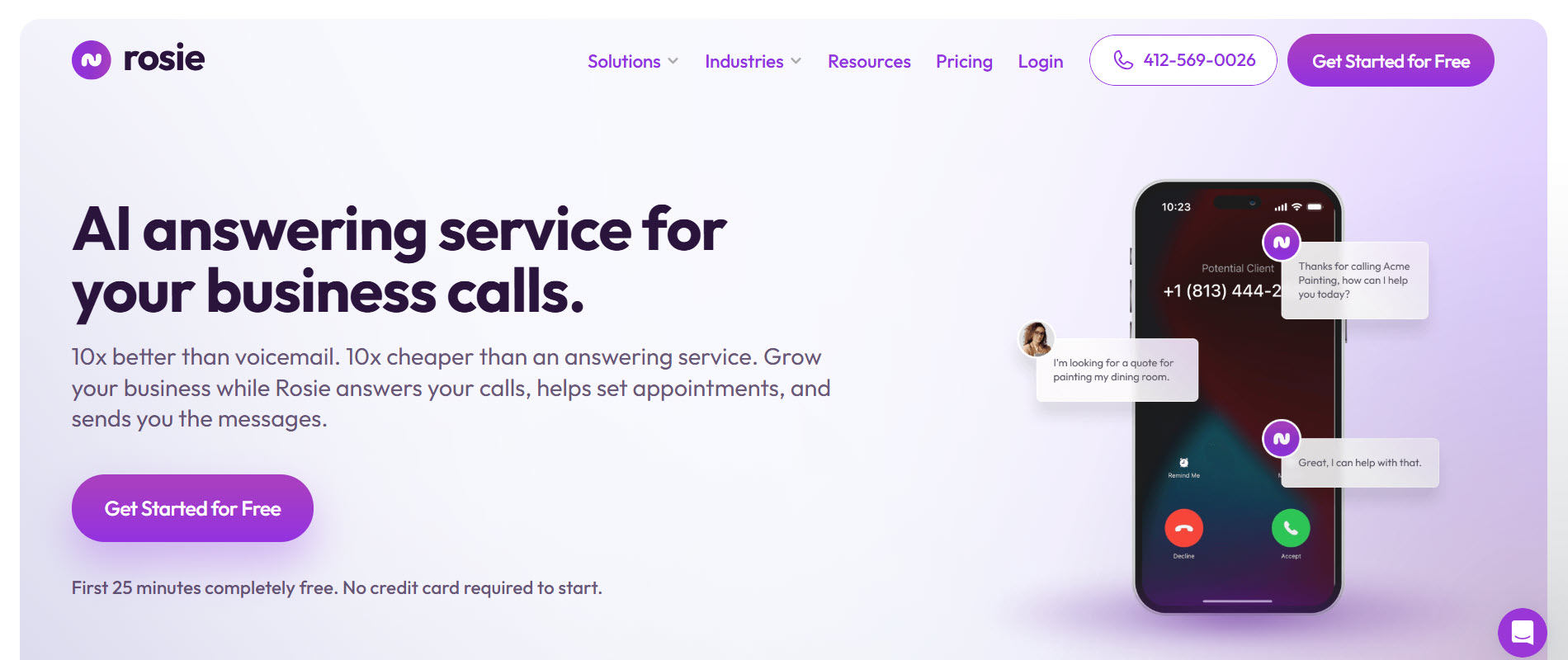
Rosie AI was the strongest performer across nearly every test we ran with portfolio companies. Setup took less than an hour. Onboarding was smooth. The conversation quality matched (and in several cases exceeded) every other tool on this list.
Standout features:
- Voice quality that consistently fooled testers in blind reviews
- Multichannel coverage across voice, text, and chat in one dashboard
- Zapier integration that connects to roughly anything you can name
- Bilingual (English and Spanish) on the base plan
Rosie isn’t built for hospital systems or 1,000-seat call centers. It’s built for the small-to-medium business that can’t afford to miss a call but can’t justify a 24/7 receptionist either. It captures leads, filters spam, fields support questions, and sends instant SMS or email alerts when a high-priority call comes in.
At $49/month with unlimited minutes, Rosie also has the cleanest pricing on the list. There’s no per-minute math to do.
2. Emitrr: Best for Appointment-Heavy Workflows

- Founded: 2019
- Headquarters: New York, NY
- Starting price: Custom
Emitrr was built for service businesses where a missed call equals a missed appointment, and a missed appointment equals a lost customer. It answers multiple inbound calls at once and writes bookings directly into your existing scheduling software.
For healthcare practices specifically, Emitrr offers HIPAA-compliant configurations. Patient data stays inside the regulatory lines. That alone makes it a fit for clinics that can’t take on the legal risk of a generalist tool.
Beyond scheduling, Emitrr can:
- Answer routine questions in real time
- Send appointment reminders automatically
- Confirm bookings via text
- Integrate with most major EMRs and CRMs
If your business runs on appointments and you can’t afford a bottleneck on bookings, Emitrr is hard to beat.
3. Slang: Best for Restaurants and Hospitality
- Founded: 2019
- Headquarters: New York, NY
- Starting price: Custom
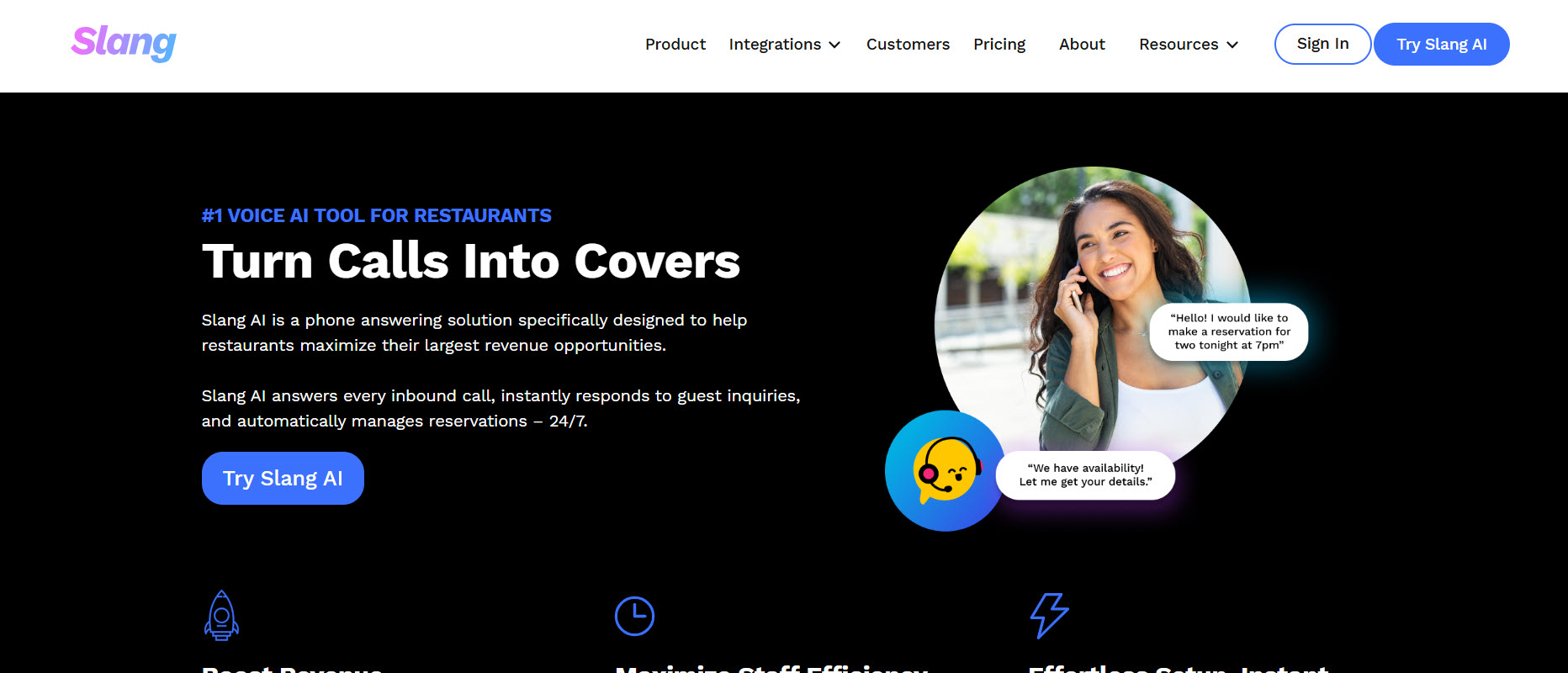
Slang.ai is built for restaurants and hospitality operators. It fields reservation requests, answers menu and location questions, and handles the kind of high-volume bursts that come with a Friday night dinner rush.
The platform can juggle multiple calls simultaneously. That matters when you’re slammed and there’s no one free to grab the phone. Reservations land directly in your booking platform within seconds.
Voice quality is a strength. Slang’s AI sounds warm and conversational, and the responses can be tuned to match your brand’s tone. For restaurants where the phone experience is part of the brand, this matters.
4. Numa: Best for Missed-Call Texting and Lead Capture
- Founded: 2016
- Headquarters: Oakland, CA
- Starting price: Custom
What sets Numa apart is what it does after a call gets missed. When a customer hangs up without an answer, Numa fires off an SMS suggesting they continue the conversation by text. That single feature has rescued a meaningful percentage of leads in the portfolio companies we tested it with. The alternative is the customer immediately calling your competitor.
Numa also handles inbound text traffic. Customers can ask questions, place orders, and book appointments without ever picking up the phone. The POS integrations make it especially useful for retail and quick-service operators.
5. AnswerConnect: Best for Frequent Call Escalation

- Founded: 2002
- Headquarters: Portland, OR
- Starting price: Custom
AnswerConnect runs a hybrid model: AI handles the front of the call, and a 24/7 team of trained human agents takes over when the conversation needs a person. That makes it a strong fit for businesses where a meaningful share of calls require nuance, judgment, or live problem-solving.
The AI manages the initial greeting, qualification, and triage. The moment the call signals it needs a human, it routes to an agent who’s already been briefed on your business. The handoff is clean. Customers don’t end up repeating themselves.
6. Nexa: Best for Complex Business Calls

- Founded: 1982
- Headquarters: Phoenix, AZ
- Starting price: Custom
Nexa is the next step beyond AnswerConnect’s hybrid model. It’s built for businesses where almost every call needs a human at some point. AI handles the routing and qualification, and trained operators take it from there.
Where Nexa earns its keep:
- Qualifying inbound leads
- Processing service requests
- Running complex intake scripts (legal, medical, B2B services)
If your team is being eaten alive by repetitive but high-touch call handling, Nexa is worth a serious look.
7. Air AI: Best for Sustained, Complex Phone Conversations

- Founded: 2023
- Headquarters: Miami, FL
- Starting price: Custom
Air AI is the standout when calls need to last 10, 20, even 40 minutes. Most AI receptionists fall apart on long conversations. Air doesn’t. It tracks context, follows tangents, and pulls the conversation back without sounding mechanical.
If you run a sales team that lives on the phone, or your support calls regularly run long, Air AI is built for that environment. It can read intent in real time and shift between sales mode, support mode, and information-gathering mode within the same call.
Frequently Asked Questions
What is an AI answering service?
An AI answering service is software that uses voice AI to handle inbound calls on behalf of a business. It can greet callers, answer questions, book appointments, qualify leads, and route calls to the right person. The best ones sound human enough that most callers don’t realize they’re talking to AI.
How much do AI answering services cost?
Pricing ranges widely. Rosie AI starts at $49/month with unlimited minutes. Most other services on this list use custom pricing based on call volume, features, and integrations. Expect anywhere from $50 to several hundred dollars per month for small business plans, and more for enterprise configurations.
Can AI replace a human receptionist?
For most small businesses, yes. AI handles routine calls (scheduling, FAQs, lead capture, spam filtering) at a fraction of the cost of a full-time receptionist. Where AI still struggles is in calls requiring deep emotional nuance or complex problem-solving. That’s why several tools on this list (AnswerConnect, Nexa) blend AI with live human agents.
Are AI receptionists HIPAA compliant?
Some are. Emitrr offers HIPAA-compliant configurations specifically for healthcare practices. Most general-purpose AI receptionists are not HIPAA compliant out of the box. If you’re handling patient information, verify compliance before you sign anything.
Do AI answering services integrate with my CRM?
Most do, either through native integrations or via Zapier. Rosie AI’s Zapier connection makes it functionally compatible with thousands of tools. Emitrr integrates directly with most EMRs and CRMs. Slang ties into the major reservation platforms. Always confirm the specific integration before you commit.
How long does setup take?
For lighter-weight tools like Rosie AI, setup can be completed in under an hour. For more complex deployments (hybrid AI/human services like Nexa), expect days or weeks of configuration and training. The more your tool needs to know about your business, the longer the setup window.
Final Thoughts
The right tool is the one that matches your specific call patterns, not the one with the longest feature list. Map out the conversations your team actually has on the phone. Then look for the service built for that shape of work.
If you want one recommendation that fits the widest range of small businesses, it’s Rosie AI. It was the strongest performer in our testing, the easiest to deploy, and the most fairly priced. For everyone else, the right pick depends on the niche, and any of the other six on this list is worth the trial.
Updated: April 22, 2026


